These
works are COPYRIGHT and CANNOT be reproduced
without James' permission in writing
BABY STRANGE
1972
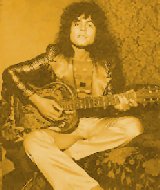
Baby Strange is one of those B-sides that
could have easily made it to the a side. It was recorded in the period
when Marc could do no wrong, that period when an artist is Midas and everything
they touch turns to gold.
If Paul Mc Cartney dreams great melodies than Marc Bolan dreamt great guitar riffs, and they simply poured out of him.
It is also a textbook piece of Bolan. The trick like all the best Bolan music is that the whole is greater than the sum of the individual parts.
Take one great riff, add some sexual lyrics, sprinkle with tight production, add enough to make it seem like everyone was having a great time and hey presto. Finally make sure that it sounds like it was done in one take and simply made up on the spot.
Actually the last part is probably not too far from the truth, the clue to this is some more recent outtakes.
It has recently come to light that there was a version of Baby Strange recorded during the Electric Warrior sessions, a rough run through only, the most prominent feature being the riff, which remained true until the final version.
And like all good Bolan work, this gorgeous riff, this simple tune drives it. Actually the cleverness of the track is that there are two guitars working at various points, complimenting each other. This was another trick in the production armoury. Technical guitar work was not Bolan's forte, but he understood that simplicity was genius. So at this point at least guitar work was kept simple and direct. Anyone could play the riff from Baby Strange, but non-one could or ever could make it sound like Marc, and that is where the genius lies.
The fact that the song in embryonic form turned up during the creatively fertile Electric Warrior period of 1971 suggests that it was a studio affair. Like solid Gold Easy Action, the riff was probably borne out of a studio jam in-between takes. Although the electric Warrior Album was full, Marc knew the value of a killer riff and it was too good to leave.
All of the above does not detract form the song, in fact it probably adds to it. It's a wonderful song, and has some interesting lyrical additions.
Marc uses his not too uncommon word bending technique; the lyrics might say one thing on the record sleeve. But that does not mean you can't bend them and disguise them to say another in front of the mic, either to avoid a ban or just fun.
It was a trick Marc often deployed and here he does it perfectly. One of the lyrics is.
'I wanna see you again.'
Marc quite happily changes this to.
'I wanna get you in bed.'
He drags out the word bed to make it as ambiguous as the rest of his image, but he does enough (just) to disguise it and requires the listener to do some further listening to hear it, but believe me it is there.
It's no surprise to see how explicit Marc could be on record, for most fans he oozed sexuality. Marc did nothing to hide this and further lyrics like.
'I'm overloaded my head exploded.'
Well they leave little to the imagination, with all the subtly of a Rothwell Carry on Script. It was a similar lyrical metaphor to 'Planet Queen'.
Marc could never great away with swearing, so the line,
'I wanna ball you all night long'
Ball could easily have replaced a graphic one syllable swear word. Ball certainly had a sort of romance meaning, which suited the album, but it is highly likely Marc had thought of another version and it is still possible there may be a demo with the colourful Anglo Saxon inserted.
It's hard to probe into lyrics that were probably quite throwaway in their nature, but amongst all the sexual posturing, all the showing off and swagger. Marc sings.
'I wanna be your friend.'
Coupled with other references at his time and Marc's later admission of loneliness this could be seen as they telling sign. Marc was terribly lonely. He was individual and isolated by nature, fame only distanced him further.
But like allot of Marc's songs at this time it was good to assert himself sexually and to further blend the lines. That was the clever part, he wasn't Mick Jagger making sure that everyone knew he was a heterosexual male and that everyone should lock up their daughters. Marc was saying he was just sexual, not heterosexual or homosexual, just pure sexuality. Which gives Marc more appeal, although inevitably it was the young girls he fell for Marc.
At this point songs like 'Baby Strange' articulated his female fans fantasies, just as early Beatles had done. And the fans knew, this blatant tapping into their own feelings was part of Marc's appeal. The most amazing use of this power is the live version from 1972 and used in the Marc's film by Ringo Starr 'Born to Boogie'. He Marc sings the song and every girl in the audience has in the least gone weak at the knees. Few male artists had up until that point used their sex appeal so blatantly and with such devastating results. The live version is a powerhouse, although it is worth bearing in mind all the songs from 'Born to Boogie' where overdubbed afterwards.
The other clever aspect of the song is that the riff is not overused.
It is only used where it fits best in the song. Rather than some artists
who would find something catchy and then simply apply it throughout the
song, Marc and Visconti apply it on the parts of the song where it is
best suit. At the beginning and at the end where it can run with incidental
studio noises from Marc. The trick of this was a core piece of Visconti's
cleverness and it was simple, everyone had to compliment everything. Nothing
should clash. Sounds simple, but strangely it's a technique rarely used.
Just as a team of people achieve by pulling together, a piece of music
works because everything in that piece works together. 'Baby Strange'
excites this perfectly, vocals given more space when needed, guitar riff
exploited to keep up interest. But never too much guitar and too much
vocal.
Nothing else really makes this track stand out in terms of production, though it is worth noting that unusually Marc's voice is lower in the mix than would be the norm at this time. The guitar is also much further forwards, no doubt because of the riff. In this song the riff was driving force as opposed to the lyrics, the drums also follow this pattern. The song starts with a drum break and Marc counting everyone in. Again this adds to the on the spot feel. Unfortunately the drums still have that flat feel that accompanied allot of early T.Rex work.
So a Slider Track and B Side that was really born out of the Electric
Warrior sessions. But songs could easily fitted to suit a albums sound,
even older tracks. And with an average period of around nine months between
albums, in fairness they weren't that old at all.
It's a great Marc track and 'Supergrass' will no doubt dig it out and some point and emulate the riff, it's certainly rife for rediscovery.